Product Description
When intracellular ERK1/2 is activated, phosphorylation occurs at its Thr202 and Tyr204 sites. After cell membrane lysis, endogenous levels can be detected using the Phospho-ERK1/2 (Thr202/Tyr204) Kit. As shown in the figure below, this kit employs a sandwich assay to detect pERK1/2 (Thr202/Tyr204) in samples. The kit contains an antibody labeled with the fluorescent donor Eu, which recognizes p-ERK1/2 (Anti-pERK1/2-Eu), and an antibody labeled with the fluorescent receptor A3, which recognizes ERK1/2 (Anti-ERK1/2-A3). When both antibodies simultaneously bind to pERK1/2 produced after cell lysis, Anti-pERK1/2-Eu and Anti-ERK1/2-A3 come within <10 nm of each other, enabling fluorescence resonance energy transfer (FRET). Excitation of the donor with 320/340 nm light induces emission of 620 nm light, which excites the fluorescent receptor to produce fluorescence at a specific wavelength of 665 nm. The concentration of pERK1/2 (Thr202/Tyr204) in the sample is directly proportional to the FRET signal intensity (the ratio of 665 nm to 620 nm light intensity).
Features
-
Higher stability: Store in 4°C for 14 days; and 7 freeze-thaw cycles.
-
Wider window: Larger S/B under matrix effects compared to competitors.
Performance
-
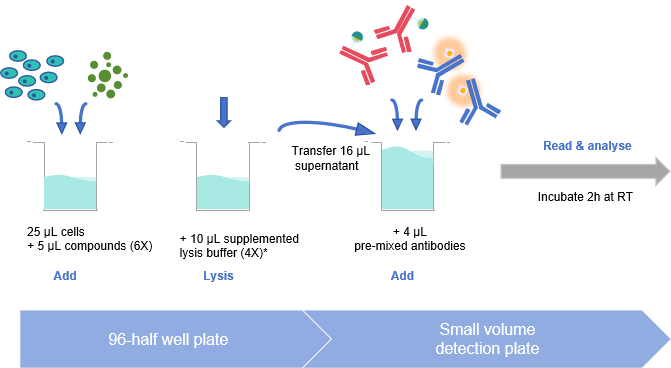
Adherent cell double-plate assay:
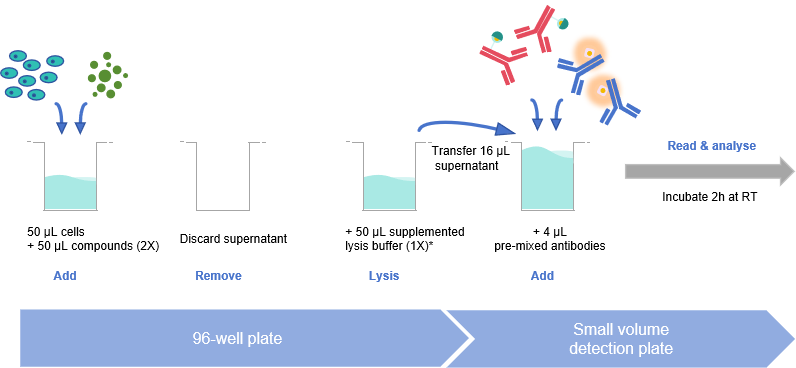
-
Double-plate assay for suspended cells:
-
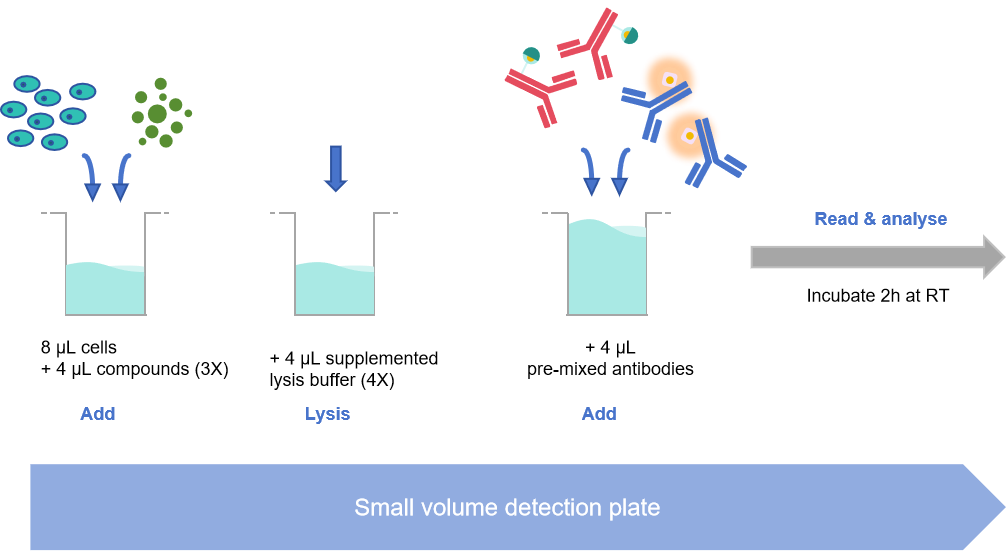
Single board determination:
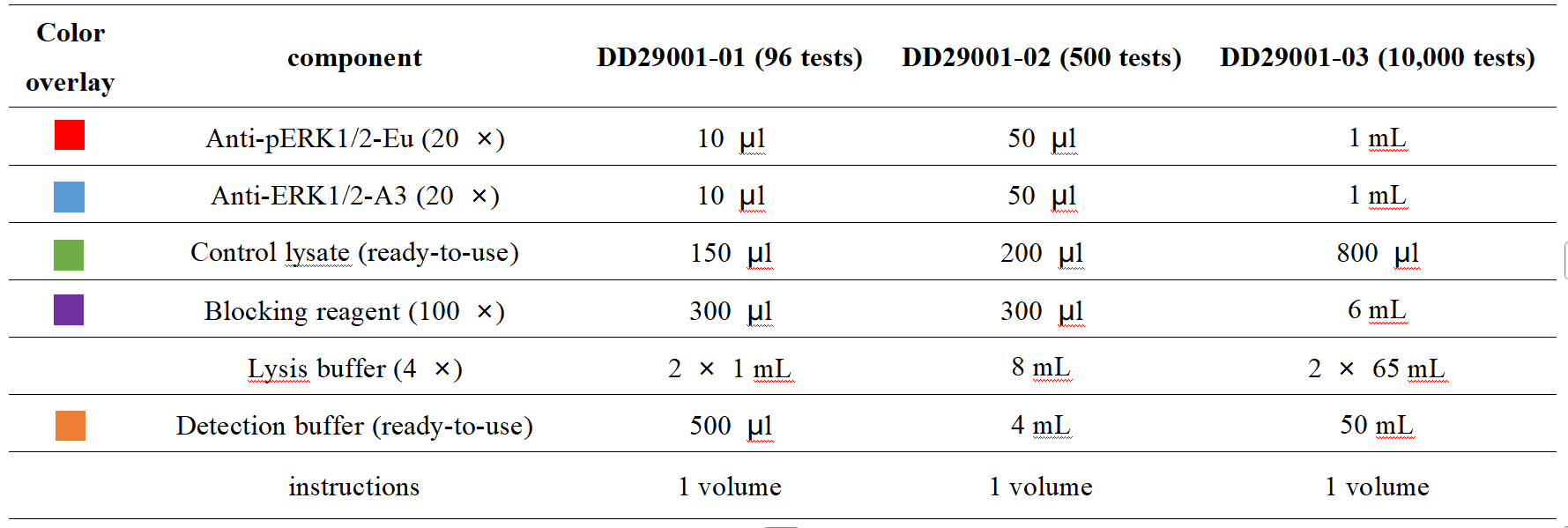
Components
 Storage
The kit should be stored at-30 ~ -15°C and transported at ≤0°C.
After thawing, Anti-pERK1/2-Eu (20×), Anti-ERK1/2-A3 (20×), Control lysate, and Blocking reagent (100×) should be stored at-30 ~ -15°C. For initial use, aliquote as needed to avoid repeated freeze-thaw cycles (≤5 times).Thawed Lysis buffer (4×) and Detection buffer (ready-to-use) can be stored at 2~8°C.